Sunday, January 4, 2009

Blue Bird


Blue Bird


Bluejay by Ray Yeager


Friday, January 2, 2009

Celestial Celebrations - Champagne


Stellar Champagne


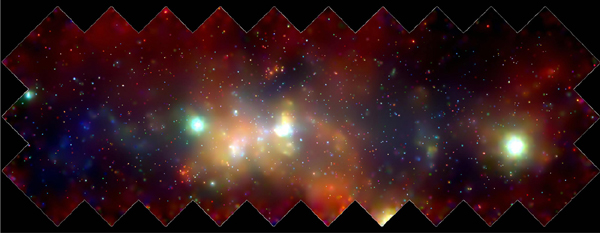
Credit: NASA/UMass/D.Wang et al.
Central region of the Milky Way Galaxy.


Judging by this image of our home galaxy, the Milky Way, we are swimming in sparkling 'champagne' of all colors. Celebrating the International Year of Astronomy requires champagne and what better way of doing that than soaking up what the universe provides us? I've selected a few images that makes me think of champagne one way or another.


Credit: NASA/JPL-Caltech/A. Tappe and J. Rho (SSC-Caltech)
Supernova (N132D) exploding 'pink champagne'.


Pink champagne is fun. A bright pink dash of sparkling champagne in form of a super duper supernova explosion does the trick in celestial celebrations.


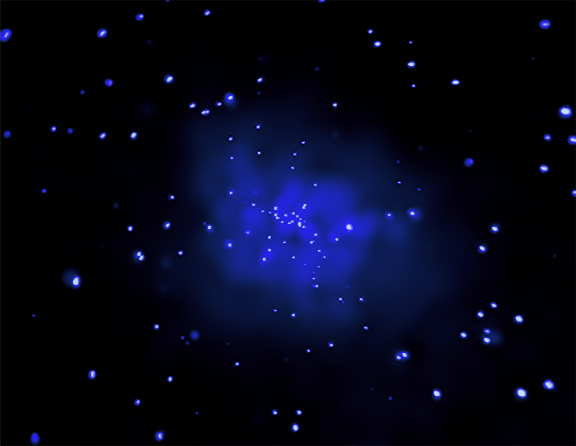
Credit: NASA/CXC/MPE/A.Finoguenov et al.


I am a sucker for blue drinks. Whatever blue I'm served, I drink...The ultimate champagne would of course have to be blue. This elliptic galaxy (M84) is not only blue, but contains bubbles in bubbles like a Russian Doll. On top of that the bubbles is formed with relativistic speed. Definitely a stellar party champagne.


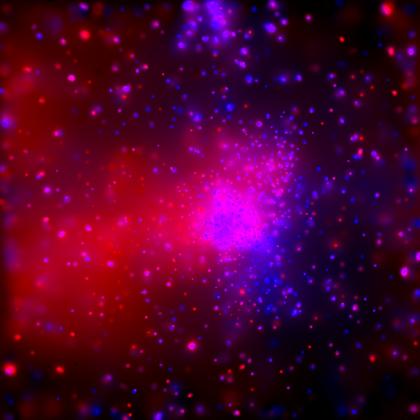
Credit: NASA/CXC/MPE/W.Pietsch et al.
Andromeda Galaxy (M31), our closest neighbour.


When you organize a party it is common hospitality and good manners to invite your neighbour. The Andromeda Galaxy is our Milky Way's nearest neighbouring galaxy. Eventually we will merge. What better way to do that but in blue and bubbly showers of champagne.


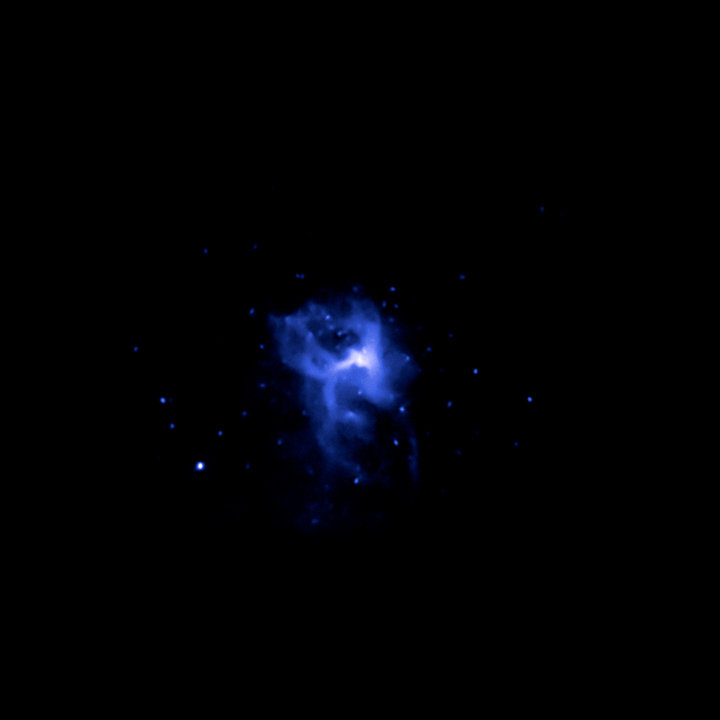
Credit: NASA/CXC/PSU/L.Townsley et al.
Horseshoe Nebula (M17) uncorked champagne.


So let's pop the corks of champagne, like in the Horseshoe Nebula where the gas flows like champagne out of a newly opened bottle, and celebrate the International Year of Astronomy in both pink and blue!

And here is the Fireworks!


PS. If you couldn't care less about partying and champagne but are genuinely interested in the real astronomy, feel free to click on the images. They lead to the original sources and more astronomical information. :-)

Galaxies


Looking at you, kid!


Credit: NASA/JPL-Caltech/STScI/Vassar

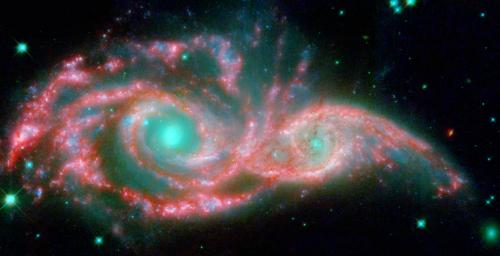
Merging galaxies (NGC 2207 and IC 2163) in false colors. Spectacular!


The Sun


Solar Eclipse


Credit: Eckhard Slawik


Dave has made an excellent selection of astronomy and space images 2008. This shows the event of a total solar eclipse in August.


Nebula


Ring Nebula


Credit: ESO

This black-and-white image of the Ring Nebula is for my friend Paul (aka Frannyy) who will suffer big time when we hit 2009 as both Stellare and PlanetBye will blow up in a feast of colorful fireworks...


Time keeper


Synchronize Your Watches!


Add 1 second at midnight!


An example of geodesy for those unfamiliar with the topic: The earth does not rotate at a constant speed, and it wobbles, whereas atomic time is extremely consistent. The accuracy of atomic timescales like UTC is essential for the smooth running of applications like GPS and the internet. So from time to time (NOT in a random matter!) we need to adjust the time. Another good consistent time keeper is the pulsar. In fact, we use the pulsars to correct the atomic watches. You get the picture.

Listen to the puls of a pulsar.


Thursday, January 1, 2009

Celestial Celebrations - Fireworks, Champagne & Bubbles


Fireworks


The universe is one giant hall of fireworks with Big Bang as the mother of all fireworks.


Artwork by Adolf Schaller for STScI
This is an artist's concept of the onset of stellar light. We are not sure if it started directly as stars or quasars. Read more about it here.


When celebrating the New Year, the very International Year of Astronomy 2009, we need not go outside the theme of the year. We find all the fireworks we want right out there in the universe itself.

There are numerous phenomena that qualify as celestial fireworks; quasars, colliding galaxies, supernovae, solar eruptions and much more.

First Light


Credit: Credit: NASA/JPL-Caltech/A. Kashlinsky (GSFC)
This background light stam from the universe's very first groups of objects. We do not know if those object were huge stars or quasars. Learn more reading The Universe's First Firework and Brief history of the universe.

Credit: NASA/CXC/M.Weiss
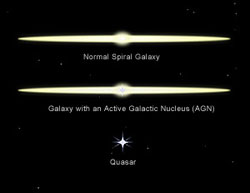
Quasars are peculiar astronomical objects that radiate as much energy per second as a thousand or more galaxies, from a region that has a diameter about one millionth that of the host galaxy. On the illustration above you see a comparison between a galaxy, an active galaxy and a quasar. Note that it is NOT a star! Click on images for more intel.


I'm deeply intrigued by quasars, exotic and still mostly mysterious as they remain even today. However remote and little understood , the quasars play a pivotal role in our daily lives here on Earth. I'll return to these feisty firery objects and why they play a major role in your life later, I promise.


Galaxies of Fireworks

Credit: Gemini Observatory /Travis Rector, University of Alaska Anchorage
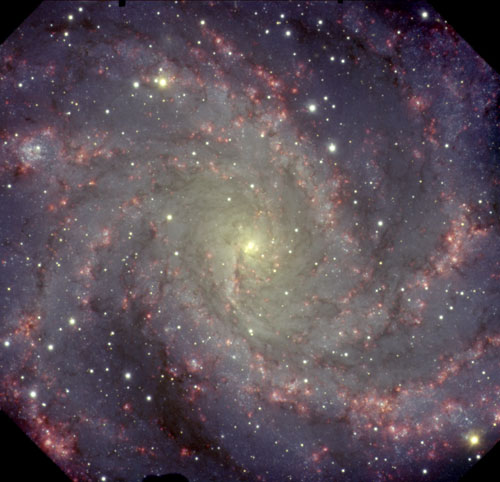
The Fireworks Galaxy


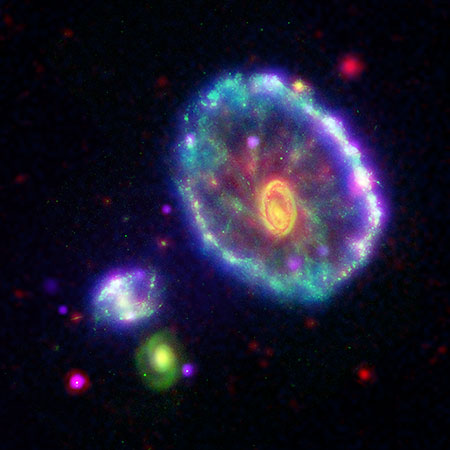
Firstly though, I'd like to properly kick off the International Year of Astronomy here on PlanetBye . I've put together a celebrating selection of celestial fireworks starting with the Fireworks galaxy(image above). Yes, we have named a whole galaxy Fireworks, but there are other galactic feasts making this a hell of a party. We have of course different kind of pinwheels; two Pinwheels actually and a Cartwheel for starters.


Credit: NASA/Caltech
The Pinwheel Galaxy seen in infrared.


Credit: ESA
Runaway galaxy (UGC 10214) - happens all the time when you deal with fireworks...


A proper celebration lasts at least three days to an end and contains a lot of bubbly champagne. I am most certainly a champagne girl so I have taken a close look at the heavens and found both champagne and plentyfold of bubbles for you to enjoy the next few days to come.

Credit: NASA/JPL-Caltech/P. N. Appleton (SSC-Caltech)
The Cartwheel Galaxy


Happy New Year!


Have some champagne with plenty of bubbles, and add a grande finale of bubbles to that!