skip to main |
skip to sidebar
WASP discover 10 new planets
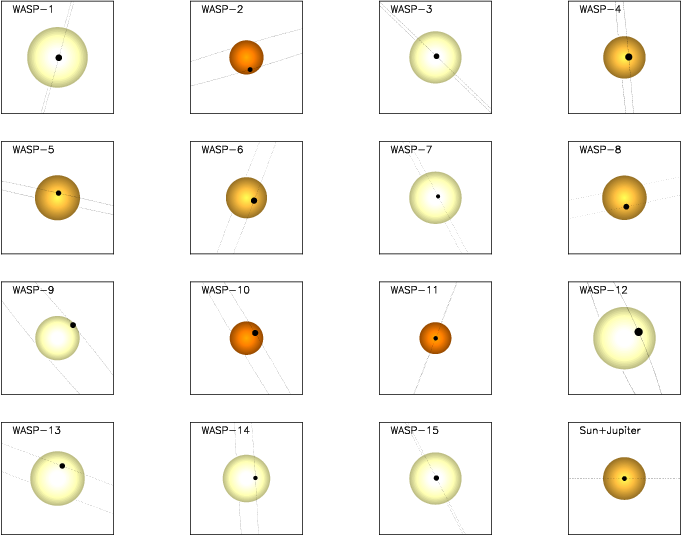 The (Super)WASP project has a discovery of ten new planets - the largest individual haul for any transiting planet survey. WASP has now discovered fifteen new exoplanets all together!
Man, don't you wish you had...

Balls of Fire!
No worries. This is what you do. Set up this experiment!
Nanoparticles in ball-lightning-like fireballs
 "The enigma of the natural ball-lightning phenomenon, reported by eyewitnesses as glowing luminescent objects floating in the air on rare occasions, has attracted scientists for more than a century. A model proposed by scientists at ESRF, explains the formation of ball-lightning as normal lightning that strikes the ground and ejects a plume of Si, SiO and SiC nanoparticles whose oxidation sustains the glow of ball-lightning."
Super Duper X-Ray Machine!

X-raying amber: The phase contrast micro-tomography employed at ESRF allows scientists to virtually extract the insect from the amber. This is a wasp from the family Falciformicidae.
European Synchrotron Radiation Facility
From my former life - I used to be part of the international management of the European Synchrotron Radiation Facility, Grenoble. I have very good memories from Grenoble.
They discovered synchrotron radiation as a disturbing side effect at CERN. As an astrophysicist you know ALL about electromagnetic waves - including the fascinating synchrotron radiation (which may be described as highly intense and focused x-ray radiation).
Discovering dino bugs in opaque amber is one really cool application of the super duper X-ray machine! :-)
Peanuts!

Credit: Image by Kevin Gecsi, courtesy of Ohio State University"Ohio State University astronomers and their colleagues have discovered a new type of star system, one that may be the progenitor of a rare type of supernova. The star system is called a "yellow supergiant eclipsing binary" -- it contains two very bright, massive yellow stars that are very closely orbiting each other. In fact, the stars are so close together that a large amount of stellar material is shared between them, so that the shape of the system resembles a peanut."
Long Live Tasmanian Devil!

I love cartoons, always have, always will. One of the fascinating characters is the Tasmanian Devil. I learned about the cartoon version before I knew there were a real animal called by the same name.
Now, the animal is in danger of extinction due to facial cancer. I hope we get to keep both the cartoon and the real world animal for ever. :-)








 Posts
Posts


