Saturday, October 4, 2008

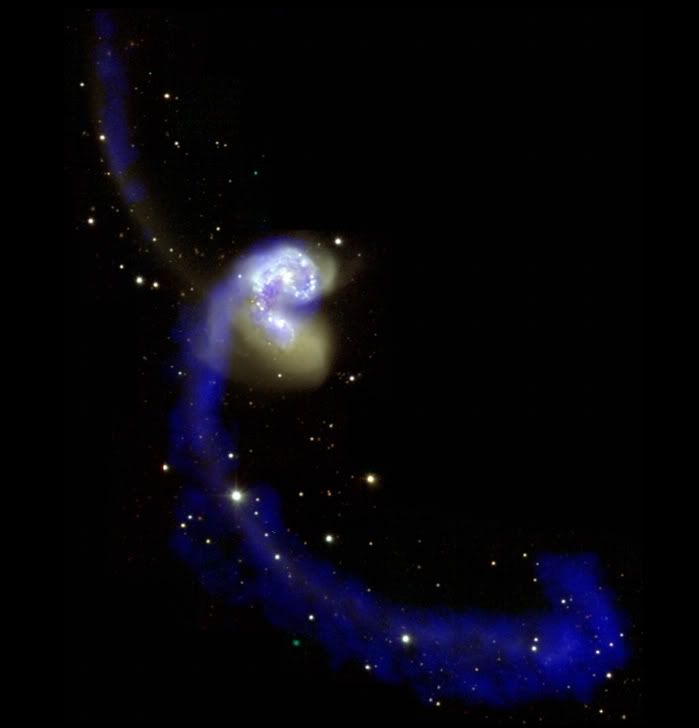
The Antennae


The Antennae - Two Colliding Galaxies


Credit: NRAO/AUI and J. Hibbard


I used to drink a lot of those - colliding galaxies that is. I am still alive?!


Physics of Bugs


Dragonfly


Stop-action dragonfly flight. The photographs on top show pairs of mirror-view images of a tethered dragonfly (Libellula pulchella) during one period of hovering motion. The colorful bottom images display calculated air flows at four representative times in the dragonfly's wing-stroke cycle. In these simulations the dragonfly's body is horizontal and its head is to the right. White lines indicate cross sections of the fore and hind wings, which are separated by about 1 cm. Red areas indicate counterclockwise swirling, blue represents clockwise motion.


Aerodynamics


Earth Observations


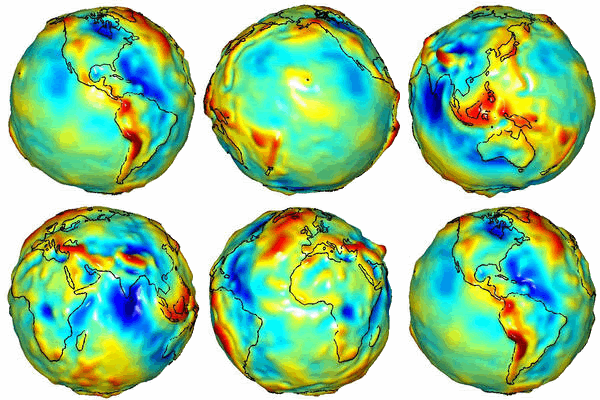
Grace & Goce


Credit: University of Texas Center for Space Research and NASA

A gravity model of the Earth constructed with data from GRACE.


GRACE and GOCE both measure gravity on Earth. GRACE measures the time variations whereas GOCE will measure the static field. We can use information about the planets gravity field for all sorts of applications and I'll mention monitoring climate change as one of the hot ones these days. Unprecedented knowledge about regional ice melting on Greenland is based on GRACE data will be published in October, adding to our understanding of sea level rise.

Oh yeah, as you can clearly observe with your naked eyes - the Earth is NOT round! :-)
Photobucket


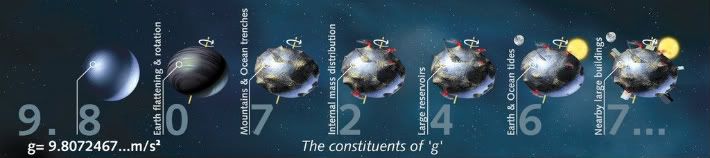
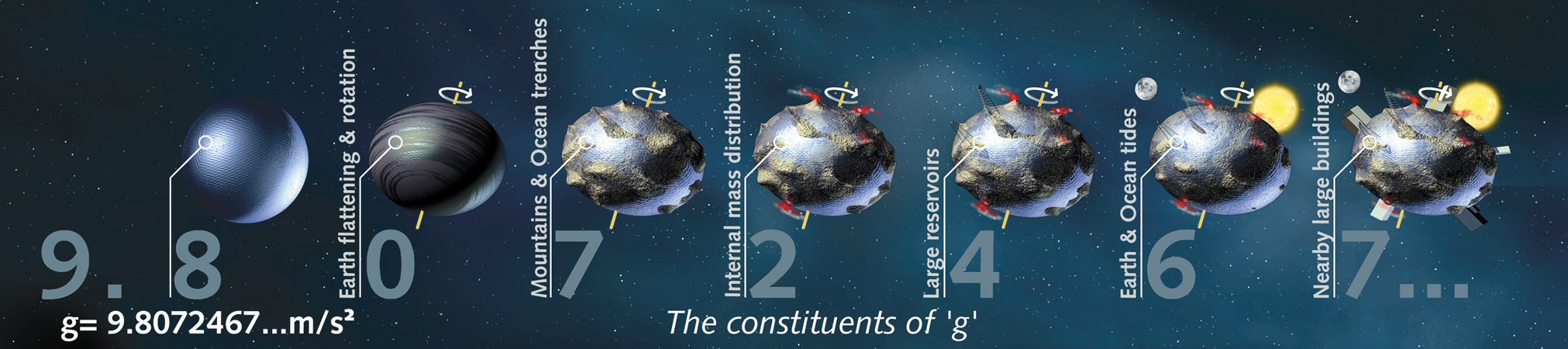
You could say that the Earths bumpiness is explained by the varying g - gravitational acceleration. We learn in school that it is a constant g=9.81. As can be seen above that is a truth with modifications. The system Earth is a little more complicated...


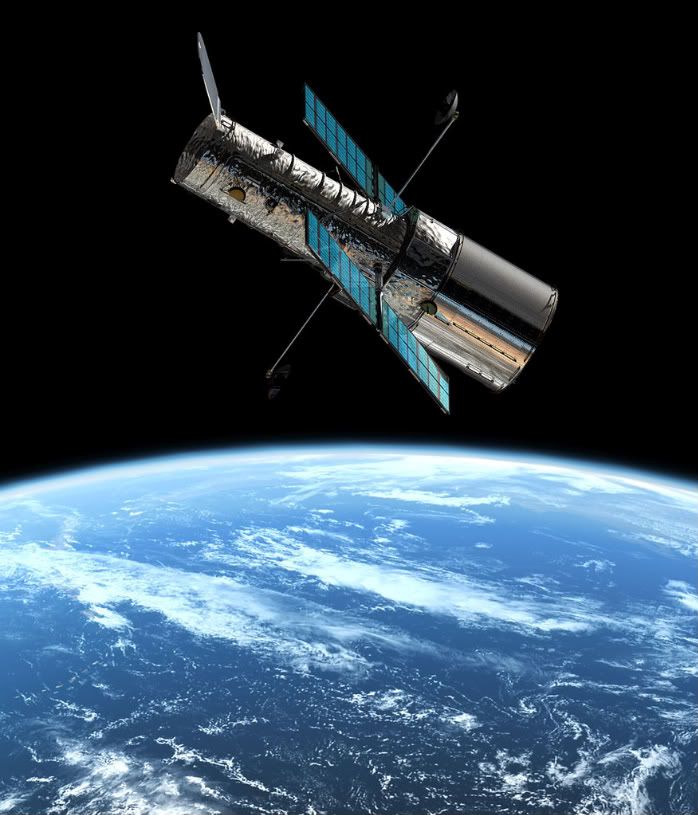
Hubble


Hubble - 10 Years


Credit: European Space Agency


The Sun


Solar Cycle


Credit: STEREO/NASA


Thursday, October 2, 2008

Jupiter


Jupiter from the Ground


Credit: ESO/F. Marchis, M. Wong, E. Marchetti, P. Amico, S. Tordo


Cassiopeia A


Cassiopeia A


Credit: NASA/JPL-Caltech/STScI/CXC/SAO


This image blends data from NASA's Spitzer (red), Hubble (yellow), and Chandra (green and blue) observatories.