Here is finally a short introduction of the Climate & Classical performance. Most of the footage of nature is recorded on the countryside in Norway where I grew up and still live.
Enjoy! And do let me know if you would be interested in working with us setting up the performance.
Showing posts with label climate change. Show all posts
Showing posts with label climate change. Show all posts
Monday, February 13, 2012

Saturday, December 31, 2011
Climate Change Rhetoric - Communicating Uncertainty
With time the details have become blurry, but I still remember the anxiety I felt the first semester as a student at the University of Oslo. When I made the decision to move from the comfort of my parent's home on the countryside to the big unknown city of Oslo I had no idea what to expect. The uncertainty felt almost complete; Oslo was an urban environment that I had hardly ever visited, I didn't know a soul and I had never been to an university in my entire life. All I knew was that I wanted to become an astrophysicist. I made a life-changing decision based on very little information.
Some of us are willing to take bigger risk than others. In certain situations we have to make decision without knowing how big the risk is. All though it can be wonderfully exciting not knowing, the professional risk takers such as extreme sport athletes, stock traders or astronauts spend lots of time and energy on analyzing risk. That implies getting an idea of the uncertainty of the available information.

As illustrated by Sir Edmund Hillary, the first to reach the top of Mt Everest, acknowledging that you do not have exact information is an important part of risk management. Credit background image of Mt Everest: ddanforth
Geolabel
In order to engage the science and technology communities in the development and use of GEO, GEO made a Science & Technology Roadmap. Among many activities in this roadmap we find the building a “GEO label” to recognise the scientific relevance, quality, acceptance and societal needs for activities in support of GEOSS. Labeling and certification are generally tools that we use to create trustworthiness and traceability. In this respect a GEO label can also function as a framework for managing uncertainty related to Earth observations
No matter how well we know the uncertainty connected to climate change or how well it is communicated to the various decision-makers, we as a society will continue to do exactly as I did when I made the choice of becoming an astrophysicist; making a decision. What do we have to loose to be aware of how good the basis for our decisions are?
About the author: Bente Lilja Bye owns BLB, a company that translates and transforms scientific knowledge for societal benefits. She is an astrophysicist that for the last decade has worked in the geosciences. Her involvement in GEO started in 2004 when she served as Research Director at the Norwegian Mapping Authority. BLB is a partner in the EU-project Egida, supporting the implementation of GEOSS.
Some of us are willing to take bigger risk than others. In certain situations we have to make decision without knowing how big the risk is. All though it can be wonderfully exciting not knowing, the professional risk takers such as extreme sport athletes, stock traders or astronauts spend lots of time and energy on analyzing risk. That implies getting an idea of the uncertainty of the available information.

As illustrated by Sir Edmund Hillary, the first to reach the top of Mt Everest, acknowledging that you do not have exact information is an important part of risk management. Credit background image of Mt Everest: ddanforth
My decision-making was a personal one that only had an impact on me, my family and perhaps my closest friends. Decisions are being made on all levels in society implicating individuals, nations, regions and in some areas a number of decisions influence the entire planet.
Decisions related to climate change are ultimately and collectively global. The Earth is such a complex system that most of us realize that we do not have an overview of the risk our planetary management represent. We know that our information contains lots of uncertainty. Decisions based on anticipations of how climate will change in the future is high-risk business.
At the coming Rio +20 United Nations Conference on Sustainable Development (20-22 June 2012) conference, our world leaders will make yet another attempt to agree on decisions related to our climate. Already 20 years ago, at the first Rio conference, further scientific knowledge and Earth observations were encouraged (Agenda 21) because that would improve the decision-making process. In the language of policy-maker that is 'making informed decisions'.
I will take a closer look at how the uncertainty of this in-demand information about climate change has been communicated and I'll be bold enough to suggest some improvements. In order to provide you with a wider perspective of the subject I'll start with describing how uncertainty is being managed in a couple of related areas.
Communicating uncertainty of natural hazards
Daily, millions of decisions around the world are being made based on uncertain scientific information. Meteorological forecasts are good examples of such information. Take for example tornados; tornados are generally thought of as completely unpredictable, but modern site-specific forecasts are today able to keep people informed well ahead of a tornado and provide enough time for them to take shelter. These meteorological forecasts, be it the regular and daily weather forecasts, the occasional tornadoes or the seasonal hurricanes, all include estimates of uncertainty. Yet, we make all sorts of important to trivial decisions based on this information. While the current information is considered acceptable and actionable, scientists are relentlessly continuing their work on expanding our knowledge, reducing uncertainty as well as finding better ways of estimating and managing the uncertainty. It is all an integral part of operational services.
The author spoke with Prof. Seth Stein (Northwestern University, USA) at the European Science Foundation-COST High-Level Research Conference “Understanding Extreme Geohazards: The Science of the Disaster Risk Management Cycle.” November 2011. Prof. Stein articulates the need of communicating uncertainty connected to hazard maps.
Climate change is a natural hazard
Climate change is a slow natural hazard and as such in principle both easier and more difficult to manage than fast natural hazards like earthquakes, tsunamis, landslides and volcanic eruptions. It is easier because we have more time to prepare ourselves for the change and mitigate its effects. It is more difficult to manage because it is so slow its effects escape our attention and we do not feel the same urgency to act.
Although the disaster risk management system is well established, addressing uncertainty is in its infancy within the fast natural hazards community. (IUGG resolution 2010 and 2005?) Prof. Stein recommend that we accept that hazard maps are “living documents” that need to be continuously improved and updated. One way of improving the maps is to increasingly use empirical data suchusing a combination of statistical and empirical ( such as validation, and assimilation of Earth observation data) approaches in the production process. Concerning management of uncertainty in hazard maps, Prof. Stein points to the IPCC's systematic way of handling uncertainty and suggests a similar approach within his field of seismic hazards.
Illustration: Risk management circle/disaster management. Pointing out where the evaluation of uncertainty goes in.
IPCC and uncertainty
Trying to look into the future development of climate, we use climate projections based on various climate models. These models and derived climate projections contains uncertainties. The IPCC addresses this issue in their guidelines for both AR3, AR4 and the latest for the coming AR5 were published 2010. However, not everybody find this satisfactory.
Climate scientist Prof. Judith Curry is voicing concerns about the way uncertainty is treated by climate scientists, in particular by the IPCC . She has written several articles on the subject arguing that the IPCC has oversimplified the issue of uncertainty in its Assessment Reports, which she warns can lead to misleading overconfidence. Curry suggests that a concerted effort by the IPCC is nescessary to identify better ways of framing the climate change problem including exploring and characterizing uncertainty. She also finds that we need to eliminate bias from the consensus building process itself. Members of the IPCC working groups have responded to Curry's suggestions and views and you'll find that the temperature of the scientific discussion is hot, making it exitingly interesting to follow. (Several links are at the end of this article if you are interested, for instance a special issue in the journal Climate Change published by Springer.)
Different kinds of uncertainty
Back in my early twenties, before I made my decision to become an astrophysicist and study in Oslo, I collected as much information as possible, but found almost nothing. I knew that I knew very little. In fact I knew that I would meet challenges that I did not even know existed, yet I made the decision. But I was prepared for the unknown uncertain future.
We all have a notion of what uncertainty is and have strategies to manage it. When we discuss uncertainty in a scientific context it is practical to distinguish between different kinds of uncertainty. We do not want to compare apples and pears. Take the Earth observations from space for instance. The processes to quality check, validate and calibrate are well defined and an integral part of the activity itself reducing the uncertainty both of the operations and the resulting observations. Meticulously designed and correctly performed experiments can be flawed just because of a malfunctioning cable, as we saw with the OPERA experiment at CERN. At a first glance the experiment seemed to have proven Einstein wrong and that it was possible to travel faster than light.
In addition to uncertainty related to human and instrumental errors we can group uncertainty in two categories: aleatory and epistemic. Epistemic uncertainty is associated with imperfections of knowledge, which may be reduced by further research and empirical investigation. Aleatory uncertainty is associated with inherent variability or randomness. When constructing climate models there will be epistemic uncertainty because we do not know if we have included all physical processes correctly, or all of them. Testing the climate models with observed data includes aleatory uncertainty.
Including information about uncertainty will definitely make the information more actionable for decision makers and then an important question is; how is uncertainty communicated outside the scientific community?
Climate change communication at American Geophysical Union (AGU) 2011
Communicating climate change is still a hot topic and I suspect will remain so in the foreseeable future. At the 2011 AGU Fall meeting the program was packed with presentations, workshops and other meetings addressing climate change. Although communicating the science of climate change is gaining attention, the rhetoric and general approach remain the same. The simplified message (in this rhetoric) is: we know the planet is in peril because of human activity and we need to act with great urgency. And fossil fuel is (the evil) to blame. I must admit I was a bit disappointed to see that even in the Town Hall meeting with the title “Directions in Climate Change Education and Communication” this same message was repeated – again and again. What is wrong with this rhetoric then?
Below you'll find a few more examples that show how the scientific community struggles to find ways to communicate scientific knowledge that include information about uncertainty in a way that is trusted, understood and accepted for decision-making.
The “Because I say so” argument
As a child I hated it when my parents tried to pull a “because I say so” argument on me. It just wasn't a valid argument, I thought. Unlike me, who respected my parent's authority, society does not even trust climate scientists, or any other experts, saying “because I say so”. Their authority is no longer recognized. This phenomena is illustrated by for instance the debate we had in connection with the so-called Climategate. Yet, the communication strategies often include arguments (rhetoric) like: 97 % of scientists agree that there is global warming. It doesn't matter what people we do not trust agree on. This authoritative “because I say so” rhetoric didn't work on me as a child nor does it work on our modern society. Whether we like the scientists loss of authority or not, it would be wise to develop a new rhetoric that takes this new reality into account.
Endorsing scientific facts by voting – IUGG and AGU
As a Norwegian delegate to the IUGG Council meeting in Perugia, Italy in 2007, I was asked to vote on a resolution concerning climate change The Urgency of addressing Climate Change. In this resolution it said: “ ...that human activities are the primary cause of the recent climate change...” with reference to the IPCC and other national and international bodies. It was a reinforcement and endorsement of the IPCC report by a body comprised of members with various background.
As a scientist I felt uncomfortable with this process, finding it to lack scientific foundation within the body I was a member of.
In its position statement Human Impact on Climate, AGU states: The Earth's climate is now clearly out of balance and is warming. That is a very bold statement approved by the AGU Council twice; in 2003 and 2007. The boldness in this particular statement lies in claiming that the climate is out of balance. Whereas claiming that the planet is warming can be supported by Earth observations, the balance question is highly speculative depending on modeling of the complex Earth system that are far from precise nor certain, and certainly cannot be supported by scientific proof or Earth observations for that matter. We can suspect and fear that the climate is out of balance, it is a reasonable hypothesis, but we cannot claim that this is a fact based on todays evidence. It is definitely not a matter that can be decided by voting.
As in the case with IUGG, the AGU Council is comprised of people with different background and competencies, voting for or against statements (hypotheses). Voting is not an element in a scientific method and therefore undermines the credibility of the entire scientific community.
Change of rhetoric
Rhetoric is the art of discourse, an art that aims to improve the facility of speakers or writers who attempt to inform, persuade, or motivate particular audiences in specific situations.
We are the most persuasive when we are found to be trustworthy and appeal to people's feelings. The current climate rhetoric might be efficient in a wake-up call phase. Al Gore with his “An inconvenient truth” wanted to scare us a bit and succeeded with that. As I already pointed out, the public no longer place the same trust in scientists as in earlier times. The scientific community need to work on re-establishing trust. The current rhetoric is also focusing too much on negative feelings or scaremongering. Even though we might find delight in being scared from time to time, it is not effective in the long run. We need to evoke more positive feelings in the population.

In his award winning documentary An Inconvenient Truth, Al Gore showed us what sea level rise would do to Manhatten, NY in USA. This unrealistic image can easily backfire when science based scenarios show much less dramatic effects.
Both the IUGG and IPCC do address uncertainty connected to climate change, but unfortunately they have not found a successful way of communicating it. By omitting or not fully inform about uncertainties, the messengers trustworthiness is at stake.
Reducing and managing uncertainty
Better access to and increased use of climate data will help reduce uncertainty and improve our understanding of climate change. Following recommendations from the UNFCC meetings, the Group of Earth Observation has worked since 2005 on implementing a Global Earth Observation System of Systems that will make data available in an interoperable way through a data portal.
Showing the carrot, hiding the whip.
In a positive environment it will be easier to communicate the uncertainty. Out starting point is more often than not, that the meteorologists do has best as they can.
Geolabel
In order to engage the science and technology communities in the development and use of GEO, GEO made a Science & Technology Roadmap. Among many activities in this roadmap we find the building a “GEO label” to recognise the scientific relevance, quality, acceptance and societal needs for activities in support of GEOSS. Labeling and certification are generally tools that we use to create trustworthiness and traceability. In this respect a GEO label can also function as a framework for managing uncertainty related to Earth observations
No matter how well we know the uncertainty connected to climate change or how well it is communicated to the various decision-makers, we as a society will continue to do exactly as I did when I made the choice of becoming an astrophysicist; making a decision. What do we have to loose to be aware of how good the basis for our decisions are?
About the author: Bente Lilja Bye owns BLB, a company that translates and transforms scientific knowledge for societal benefits. She is an astrophysicist that for the last decade has worked in the geosciences. Her involvement in GEO started in 2004 when she served as Research Director at the Norwegian Mapping Authority. BLB is a partner in the EU-project Egida, supporting the implementation of GEOSS.
Sunday, January 16, 2011
Beyond Sustainability

The library will be continuously updated with links and references to good readings on the topic. So, feel free to send me links.
Climate Change and Ancient Societies

Rather interesting statistics, I'd say.
Monday, December 20, 2010
Solar Radiation and Climate Change

"Some climatologists, including Judith Lean of the United States Naval Research Laboratory, Washington, remain skeptical of the SORCE SIM measurements. "I strongly suspect the SIM trends are instrumental, not solar," said Lean, noting that instrumental drift has been present in every instrument that has tracked ultraviolet wavelengths to date."
Monday, November 29, 2010
Big Cats And The Environment

It takes a lot of food to make this cutie pie of a leopard to grow up and become one of these...

Thursday, September 16, 2010
Hotter

Except in Norway, of course! This summer felt colder than usual - and it was too. Confirmed by NOAA.
Sunday, July 11, 2010
Climategate and global warming - Independent Climate Change Email Review Released

NO! I know. In fact, we all know. :-)
Read an analysis of the latest inquiry called Independent Climate Change Email Review, a review lead by Sir Muir Russell.
Monday, March 15, 2010
Climate change and human adaptivity

Friday, January 29, 2010
Earthquake in Haiti and ClimateGate
The February show of A Green Space - A Green Earth provides you with in-depth coverage of the science behind earthquakes, in particular the recent Haiti quake, and Earth observation data sharing with a special focus on the so-called ClimateGate.

The Caribbean island Hispanola with Haiti and Dominican Republic More.
Credit: NASA
This information is provided by specialists, communicated by another specialist and wrapped up by a professional TV- producer, former CNN director Richard Mathews.
Stay tuned - the show airs 1. February 2010.
Saturday, November 14, 2009
Climate Change Communication

Design: Hugo Ahlenius
To learn a trick or two on how to, just sign up for a workshop in Copenhagen (deadline for signing up is 20th November 2009), invite your loved ones and be inspired by both the Christmas decorations in Tivoli and the UN climate change meeting COP15. :-)
The workshops are organized by Nordpil and Envalue.
Wednesday, September 23, 2009
Climate on Mars

A radar-generated map of the thickness of the layered deposits. Image credit: NASA/JPL-Caltech/University of Rome/Southwest Research Institute/University of Arizona
We are pretty preoccupied with climate change on this planet these days. This week the Climate Week is taking place in New York City, partly preparing for the big Copenhagen meeting in December where we hope to get the replacement of the Kyoto Agreement in place. (I said HOPE).
I always say I do not discriminate against any of the planets including planet Earth. NASA must have the same philosophy. Look at this awesome study of the changing climate of Mars all revealed by laser techniques. :-)
Monday, September 21, 2009
China and Climate Change

The media will be packed with climate change articles and opinions as we get closer to the Copenhagen meeting in December. I'll be contributing to the discourse, too. This is one fresh article written about the ongoing work by among others the Stockholm Environment Institute.
I do believe China is capable of leap-frogging the western worlds polluting history. It is a question of international politics to make that actually happen...
Sunday, August 30, 2009
The Sun and Climate Change

Credit: NASA/ESA/SOHO
Solar activity have an influence on the climate on planet Earth. The question that remains unanswered with a satisfactory certainty is whether it is dominant compared to other effects like CO2.
Based on my experience and knowledge of the field it is done far to little research on the topic, mainly due to politics. It is very dangerous to even ask the questions we need to ask. It is a pity, because asking them is necessary to reduce the non manageable uncertainty of the climate models today.
The Sun is many orders of magnitude larger and energetic than the Earth. However, we do benefit from a protective magnetic field bouncing off enough to make it livable here.
I wish we could look at the Sun in this perspective in a more sober way than what is being done today.
Wednesday, July 22, 2009
Uncertainties

We need better models AND more data to fully understand or at least better so that we can make adequate plans.
I had a delightful lunch with a climatologist in Oslo today - she has set her mind on helping city planners and policy makers through visualizing climate data on maps - for their location in Norway. For some places it is clear that measures must be taken already today - like for New Orleans in USA and The Netherlands already lying below sea level. In Norway we are definitely worried about Bergen...
Thursday, July 2, 2009
Climate Change and Sea Level - I

The Mississippi delta as it would look like if land continues sinking and sea level rises one meter.
A new model predicts that 10 percent of Louisiana will be submerged by the year 2100.M.
Credit: Blum and H. Robert
There are several factors contributing to changing sea level. Today, we have not yet understood the dynamic Earth well enough to predict sea level. The uncertainties are too large for politicians and coastal managers to handle. This is the topic of my July edition of A Green Space - A Green Earth. .
Saturday, April 4, 2009
Earth Observation in Antactica
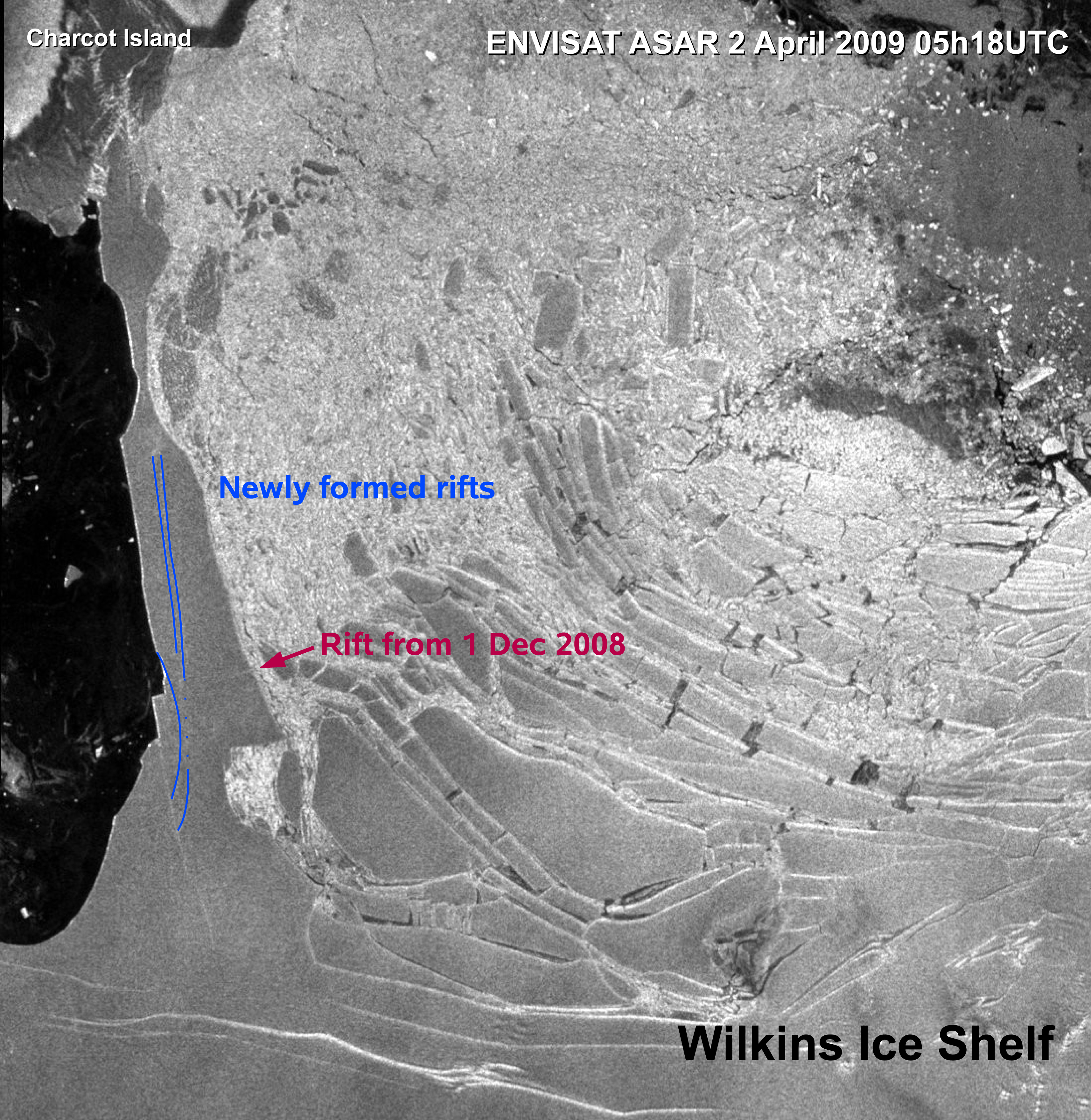
Credit: ESA (Annotations by A. Humbert, Münster University)
Click on the image for a larger view of the rift in the ice bridge supporting Wilkins Ice Shelf in Antarctica.

Credits: ESA
This map is showing break-up events of Larsen-B and Wilkins ice shelves, as observed by Envisat, in Antarctica.
Sunday, March 15, 2009
In The Arctic

Credit: UNEP/GRID-Arendal
Trends in Arctic temperature, 1880-2006.
The chart shows that there have been colder periods in the Arctic and that the latest trend is warmer than the century average.
I think this illustrates pretty well the facts of the matter. What causes these variations in temperature and what consequences a lasting warming will have are still not well enough understood and we do our best to gather more information and understanding of the complex Earth system.
Wednesday, January 21, 2009

Thursday, December 11, 2008
Climate Change Refugees

Cartographer: Emmanuelle UNEP/GRID-Arendal
Fifty million climate refugees by 2010.
"Today we find a world of asymmetric development, unsustainable natural resource use, and continued rural and urban poverty. There is general agreement about the current global environmental and development crisis. It is also known that the consequences of these global changes have the most devastating impacts on the poorest, who historically have had limited entitlements and opportunities for growth."
And yet we continue to discuss who or what causes the changes. This is perhaps the only topic that I will agree with Mrs Sarah Palin; we need to act on and adjust to climate change now. Some will argue that if we don't know what causes climate change we cannot make the right decisions. As a scientists I am of course not going to argue against understanding and knowledge production. However, we have technology and information to monitor mother Earths behavior today AND we can model pretty well the near future as well. Enough to act.
Subscribe to:
Posts (Atom)


 Posts
Posts


