Sunday, April 27, 2008

Desert


Blue Desert


Richat Rings, Sahara Desert, Mauritania, Africa


PS. False colors :-)

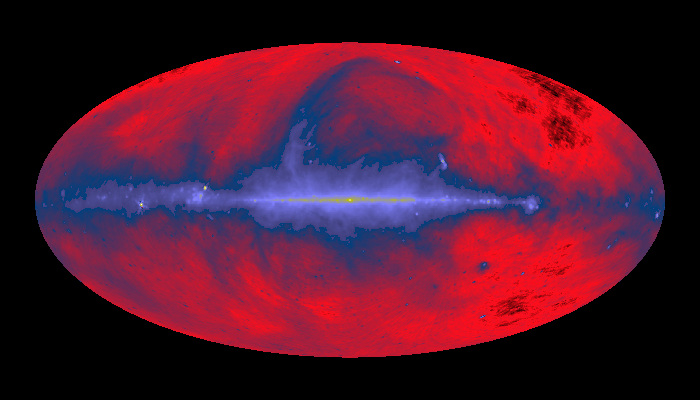
Galactic Plane


Galactic Plane


Credit: C. Haslam et al., MPIfR, SkyView

Looking at the universe in radio.


100-meter Radio Telescope Effelsberg near Bonn, Germany, Jodrell Bank, UK and Parkes, Australia are used to obtain the radio image.


Saturday, April 26, 2008

The Sun


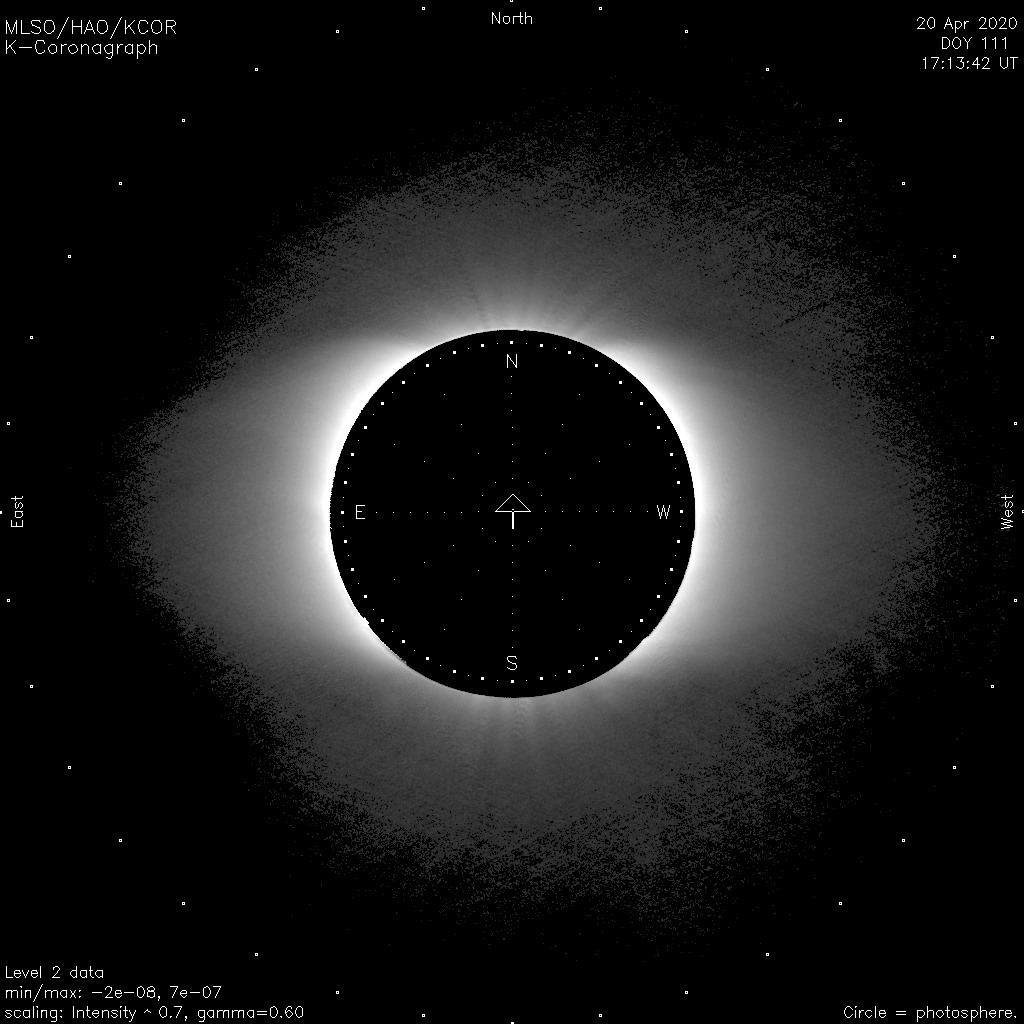
Sun - Corona

sun, astronomy

Credit: from the High Altitude Observatory Mauna Loa Solar Observatory (Hawaii)

White-light Mk. 4 coronameter images


Normally we say that the sun consist of gas. It is in fact more specifically plasma - A fourth state of matter (in addition to solid, liquid, and gas) that exists in space. In this state, atoms are positively charged and share space with free negatively charged electrons.


Friday, April 25, 2008

galileo


Galileo on its way


Credits: ESA- J.Huart


The second Galileo satellite will be launched from Kazakhstan this week-end.

Galileo is a Global Navigation Satellite System like GPS and GLONASS. All together these systems will improve our geodetic reference system substantially.

Galileo's new technology will revolutionize our transport systems, increasing safety and improving efficiency; this will make for better quality of life and less pollution in our cities. Galileo will also bring benefits in other aspects of everyday life, with precision farming raising yields, improved information for emergency services speeding up response times, and more reliable and accurate time signals underpinning our most vital computer and communications networks.

THE FIVE GALILEO SERVICES

OPEN ACCESS NAVIGATION
This will be 'free to air' and for use by the mass market; Simple timing and positioning down to 1m

COMMERCIAL NAVIGATION
Encrypted; High accuracy at the cm scale; Guaranteed service for which service providers will charge fees

SAFETY OF LIFE NAVIGATION
Open service; For applications where guaranteed accuracy is essential; Integrity messages will warn of errors

PUBLIC REGULATED NAVIGATION
Encrypted; Continuous availability even in time of crisis; Government agencies will be main users

SEARCH AND RESCUE
System will pick up distress beacon locations; Feasible to send feedback, confirming help is on its way


Credit: ESA - S. Corvaja 2008

The Soyuz-Fregat launch vehicle carrying GIOVE-B, the second of ESA's two Galileo In-Orbit Validation Element demonstrators for the Galileo global navigation satellite system, is erected on the pad of the launch complex at the Baikonour spaceport, Kazakhstan.




Thursday, April 24, 2008

Solar system


Life expectancy


Details of our Destiny?


(Illustration: NASA/JPL-Caltech)


A catastrophic collision with Mercury or Mars may be in Earth's future as the sun develops into a red giant.


Tuesday, April 22, 2008

Environmental Clash


Environmental Clash


A sewerage system situated practically ON the lake? Perhaps it looks clean, but it SMELLS and God knows how much of it leaks out in the lake it is supposed to clean.


Gro Harlem Brundtland uttered the famous environmental words: Think global, act local.

Indeed, it is important to have the locals on board and as allies when implementing environmental projects. That is why it is paramount that the projects actually give the promised results - or at least some improvements. :-)

The environmental movement in China is very much aware of the need of individual engagement. One of the green organization uses the train as means of reaching the people in remote corners of China.

The same requirement of being practical and useful applies both in Norway and China and everywhere else.


This is a post in the Earth Day series.


Earthquakes in Norway


Small Country, Small Earthquakes


Stourragurra fault in Finnmark, Northern Norway


I know what I'm made of; organic material or biomass if you like. As such I cannot distinguish myself from the other biomass composing the biosphere of the Earth and therefore not the Earth itself. However, for the sake of my point I will talk about the Earth as opposed to humans and human activity and of how we can protect both Earth itself and what we as humans construct out of and on the Earth.

There is nothing we can do about earthquakes, volcanoes, tsunamis and other natural hazards on Earth. What we can do is to understand and try to predict this violent behavior of the planet, and by that protect both ourself and the planet from the consequences.

I am particularly thinking of how we can avoid building nuclear plants and the likes on top of a volcano or in a earthquake prone area. We can also calculate the expected shaking and construct our houses so that they can at least last smaller quakes.

Norway is prone with earthquakes. It is not only the fact that the country is small and remotely situation up north that might make you feel ignorant not knowing the first thing about Norway (perhaps :-)), it could also be the fact that the earthquakes are relatively small and therefore less talked about.

However small Norway is population wise with its less than 5 million people, it is a big oil, shipping and fishing nation. Norway has therefore obtained substantial information about its earthquakes. Imagine what could happen with oil and gas pipelines etc if the Earth shook them hard enough?

Understanding earthquakes and other natural hazards is therefore of out most importance also in an environmental perspective.

Photobucket

Earthquakes in and around Norway. Read more about them by clicking on the map. (NORSAR)

This is a post in the Earth Day series.